
 There are those in Scotara who believe magic was never something brought into the land… it was born of it.
Long before kings ruled from stone keeps and laws were spoken from high walls, it is said the land itself held a presence—something unseen, yet felt in forest, field, and water alike. It moved through the roots of trees, stirred beneath the surface of streams, and rose with the wind that swept across the hills. Some believed it shaped Scotara. Others believed it was Scotara.
In those earlier days, magic was not set apart from life. It was woven into it. Not every hand held it. Not every moment revealed it. But its presence was acknowledged in the way people lived, in the things they honored, and in the rhythms they kept. The turning of seasons was not taken lightly.
Spring was welcomed with offerings of early blooms, placed along doorways and at the edges of fields, a quiet gesture of gratitude for life returning. Summer was marked with gatherings that lasted well into the evening, fires lit not for warmth, but for celebration—light rising to meet the sky as the land stood at its fullest. Autumn brought a different kind of reverence. Harvests were gathered with care, not only for what was needed, but with an understanding that what was taken must be respected. It was a season of thanks, though not always spoken aloud, and of preparation for what would follow.
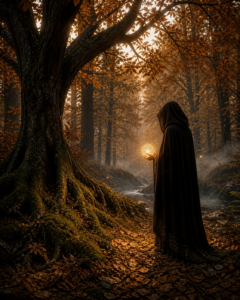
Winter was quieter still. The land was understood to be at rest then, its strength drawn inward, lying dormant beneath frost and snow in preparation for the return of spring. It was not a season to resist, but one to respect, a time when life slowed and the world held its breath. Candles were lit early and often. Fires were kept burning, not only for warmth, but with purpose. Light was tended carefully, watched and fed, as though it held more than flame alone. It was believed that where light endured, darkness could not take hold… could not settle too deeply… could not claim what did not belong to it.
Doors were closed against the cold, but within, life gathered close. Voices softened. Movements slowed. And through it all, there remained a quiet understanding that even in stillness, even in the longest nights, the land was not empty. Only waiting.
Not all believed in it in the same way. There were those who trusted it, who felt no need to question what had always been. Others kept their distance, wary of anything that could not be fully understood. And there were some who believed that while magic belonged to the land, it did not always belong in the hands of men.
Still, it remained part of Scotara, in belief, in custom, and in the quiet acknowledgment that there was more to the world than what could be seen.
Time has a way of changing such things. What was once accepted becomes questioned. What is questioned becomes doubted. And what is doubted… is often set aside. Yet even now, with so much no longer spoken of, the old ways have not entirely faded. They remain in small traditions. In the way certain seasons are still marked, even if the reason has long since softened. In the instinctive respect shown to land and water alike.
And in the quiet belief—held by more than a few—that what once belonged to Scotara may never have truly left it.